


DepartmentHispano
marco
NameTin frame
Artist
Isleta Tinsmith
CultureNew Mexican
Place madeNew Mexico, United States, North America
Mediumtin, glass, paper, solder, paint, foil
DimensionsOverall: 29 3/4 x 24 13/16 in. (75.5 x 63 cm)
Credit LineGift of Steve and Dottie Diamant
Object numberA.2005.49.5
Collections
Provenancecollection of Steve and Dottie Diamant, owners of Fine Arts of the Southwest
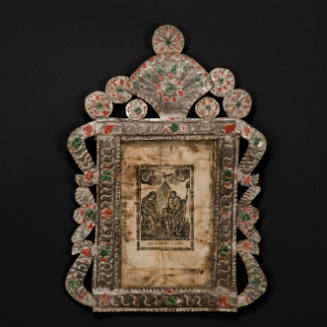
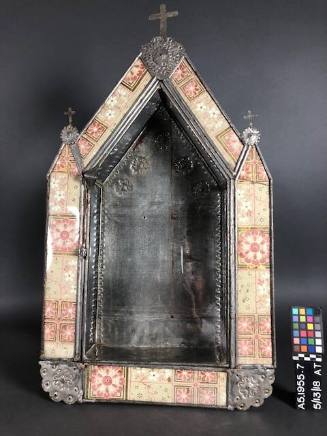
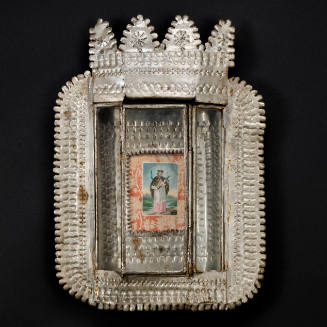
DescriptionLarge tin frame (marco) with fan-shaped corners that are embossed with small and large rosettes. Both stamped and embossed dots and a crimped edge. The two acanthus leaves on either side are embossed with the dot and rosette designs. The lunette continues with the same designs with the rosettes embossed and the rows of dots both stamped and embossed. The reverse-painted glass framing panels have blue paint with brush stroke relief on the side facing the viewer, with red, white, & gold paint on top showing through the brush strokes where the artist removed the blue paint. The chromolithograph is of Saint Corona, an early saint who was martyred for refusing to renounce her faith. She is suspended between two palm trees by her wrists and chained to a circular block by her feet, suggesting the brutal manner she was executed in (CG). The Roman soldiers on each side, one in red and one in green, hold on to the ropes, ready to execute her. Before she died, Saint Corona said she saw two crowns in heaven for her and Saint Victor, who was also martyred in Roman Syria. The letters "CIGAR" run vertically down the front of the figure, where the artist was unable to remove a stain on the glass left by the paint. Flecks of silver, black, and red pigment are still visible on the glass, even though the artist was diligent about scraping it off. This is likely part of a glass panel from a display case for cigars from a trading post or mercantile (CG).This marco is attributed to the Isleta tinsmith, an anonymous tinsmith working at Isleta Pueblo from about 1890 to 1920, who oral history from Isleta Pueblo remembers simply as "The Mexican." The articulated pediment, created by scoring, and the embossed rosette designs are all indicative of this artist's hand; as is the reverse-glass painting with brush stroke relief, and acanthus leaves on either side. This artist frequently embossed designs of three rosettes together, as seen on the corners and leaves of this marco, most likely signifying the Holy Trinity. The original soldering on this piece is intact, and the chromo is also therefore original. - Carla Gilfillan


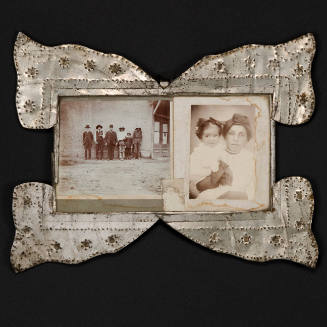
Isleta Tinsmith
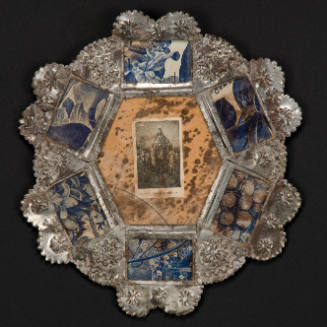
Artist not recorded

Isleta Tinsmith
c. 1885-1920
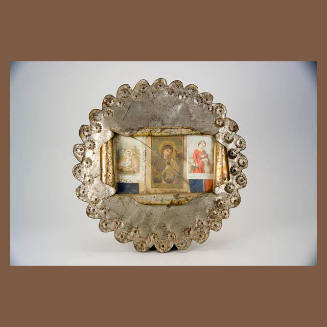
Rio Arriba Tin Workshop
José María Apodaca

José María Apodaca